So long, and thanks for the yurts: The end of Occupy

In the end, it came down to a single yurt. The police, who were going to great lengths to smile at everybody, had formed a circular cordon around the library yurt, wherein a sole resistor had holed himself up. After what may have been the world’s longest police negotiation with an unarmed man in a yurt, he was arrested with equal parts delicacy and manpower. The half-dispersed crowd stood around, occasionally mustering a chant of “Don’t hurt the yurt!”

The yurt was not hurt. The unions had paid good money for it. It was dismantled – colourful outer skin, construction grade weather-proofing, a hairy inner layer and then wood skeleton – and piled into a rental truck that had been backed onto the lawn. All the other tents had already been carted off. One guy had climbed a tree, and was yelling “Occupy your trees! Occupy your trees!”, to little evident effect.

Workers crowbarred up the wooden crates that the yurt had sat upon, and crushed them in the back of a garbage truck. Across the park, police processed their handful of detainees on the spot. A young woman slid in to rake up the leaves that remained, and Occupy Toronto – a day earlier, a roiling little community – was gone.

On the surface, we’d seen so much of it before: The willy-nilly assemblage of activists, the jumble of beliefs and demands, the cocktail of idealism and grievance. Yet Occupy managed to become more than the sum of its parts. Far from the camp-site, I kept hearing comfortable members of the middle class who, in other years, would have rolled their eyes and changed the channel, voicing their support.

Perhaps the best way to understand Occupy wasn’t to look at it too closely. Up close, it was too easy to get caught up in the vivid details: The cacophony, the squabbles, the characters, the “characters,” the prayerful quality of the assemblies, in which hundreds would amplify a single speakers’ voice by repeating it en masse, phrase-by-phrase, sounding very much like the congregants in St. James Cathedral above them. In theory, this was a democratizing action. In practice, one wondered if mass-recitation had the same pacifying effect on anarchists as Anglicans.

In New York City, Zucotti Park had been transformed into a solid, malodorous mass of tents, but Occupy Toronto had built an impromptu village, with little cottages, larger structures, common spaces and thoroughfares. The local dog-walkers may have disagreed, but it was an intriguing use of public space. As attractions go, a semi-autonomous self-policing quasi-anarchist state is a pretty good way to animate a park.

Like the Occupy movement in general, the encampment was a Rorschach blot. A visitor – especially a visitor with a column to write – could find evidence for pretty much any take they wanted. If you wanted to find a wingnut so you could complain it was populated by wingnuts, you could. If you wanted to find an achingly earnest student so you could complain it was run by the entitled, you could. If you wanted to find an anarchist, so you could ask what anarchists actually believe (it’s hard to pin down, but it never quite seems to be anarchy), there were plenty of those, too. It was a street movement, and it embraced the unruliness of the streets and those who live on society’s fringes.

But, of course, it was more than just a bunch of people hanging around in a park. The Occupiers brought with them an entire system of governance, like colonists bent on enacting utopia on virgin shores.

One night, not long before the eviction, a squabble broke out between the folks at the south end of the park, who were having a great rumpus around the drum circle, and the folks at the gazebo who were trying to talk strategy. A delegation went down to the drum circle to entreat them to kindly shut up.

This was done in the best Occupy spirit. Arguments went back and forth through the “people’s mic,” interspersed with heckles, asides, and furtive thumps from the one guy who wouldn’t put his drum down. The leaders patiently explained that it was late, the neighbors would be upset, and other Occupiers were trying to work. When this didn’t wash, other arguments were trotted out.

“We’re prototyping a new society here!” said one young man.

“I’m a hippie!” shouted a boomer on the fringes. “I’m not going to take any bullshit!”

Insisting on drumming, said another, “is kind of a 1% thing to do.” The speaker suggested that Occupy values might best be expressed by chanting. There was a bit of humming, and then silence. But the drumming had stopped.

There was more than a little gong-show to the process. But on the other, here were these people, engaging in the messy business of organizing a scraggly assortment of citizens through the most peaceful of means. Consensus-building is not an inherently flawed way of doing business; merely a tricky one.

Which brings us back to one of the basic contradictions of Occupy: Was this a protest against injustice and inequality, or an experiment in creating a new community? The Occupy answer to this, as to everything else, seems to be “Both! At the same time! Everything at once!”.

This was part of their argument for being allowed to stay in the park on Charter grounds: The values they espoused at the camp, they argued, were an enactment of the changes they wanted to see in society, and so the camp itself was an act of expression.

And while this was an intriguing thought, it was an odd move for a protest movement: If they’d been legitimized, it wouldn’t have been an occupation; it would have been a camp-out. And if the Charter recognized the creation of utopian micro-states as an act of free expression, then I would waste no time barricading the Dufferin underpass with Canada Post boxes and declaring the People’s Republic of Parkdalia.

This would not be a workable precedent. But the Occupiers had a point: You can’t separate the protest from the camp, because the peaceful, engaging, talkative, inclusive values they espoused there were critical to their appeal.

Occupy achieved something that the general activist movement has failed at doing for years: It mounted a sustained, peaceful protest that caught the attention and sympathy of the comfortable middle classes. It was formed in a moment of profound popular distress at the way the world is unraveling; it was at once a symptom and cause of unrest. Its presence sparked a million dinner-table conversations, and became a platform for political action in other parts of the system. It’s helped to reopen discussion about bigger items of social consensus that had long-since been assumed to be closed.

The fact that Occupy decided to decamp without violence has left its legacy intact. It has social capital to spend, even if it’s short on real estate. But then, I think Occupy had a bigger agenda than occupation: It was building a big-yurt movement. May it continue.


This piece was originally published in The Toronto Standard
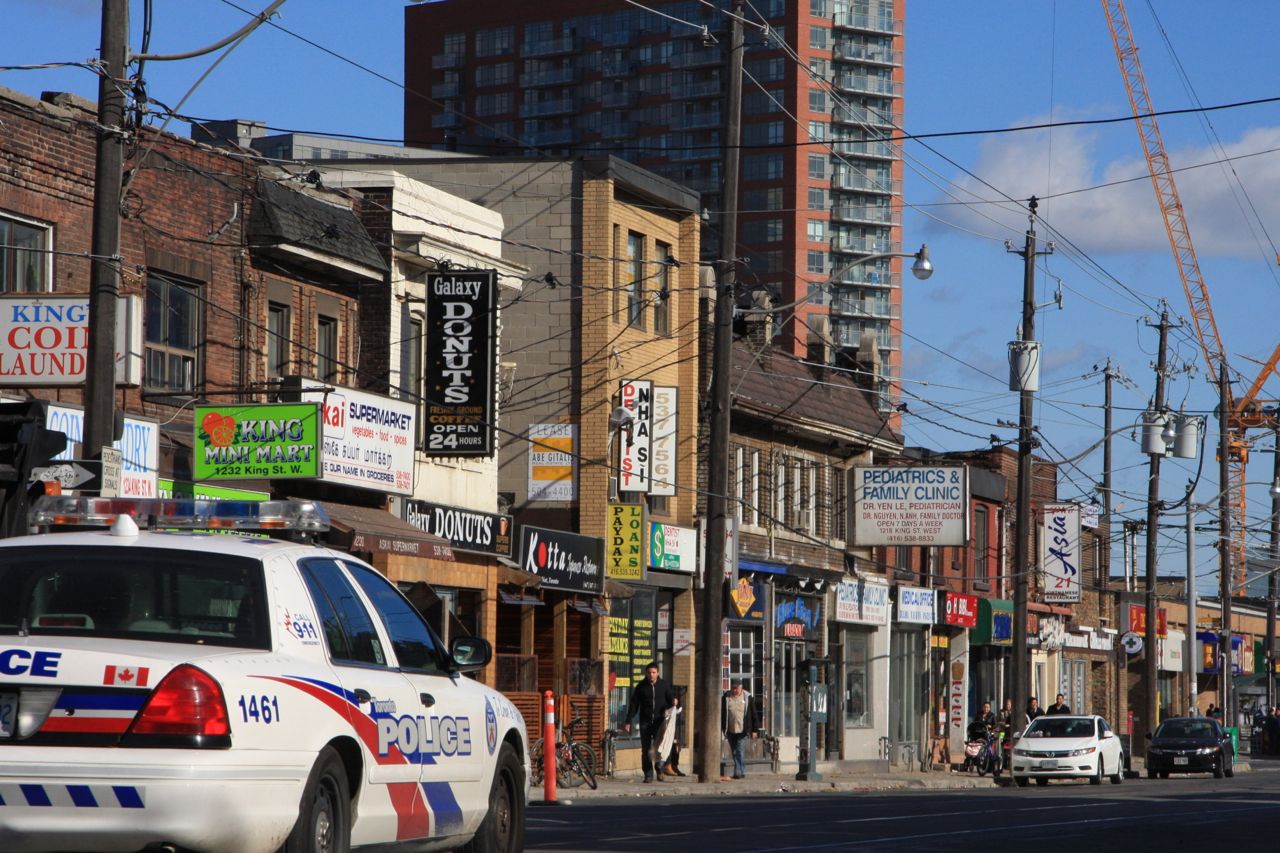
In Parkdale


One thing about hanging out with a dead cat in Parkdale is that people talk to you.

“I went to try to get latex gloves,” said the burly guy with the Jamaican accent, who’d seen the cat get hit. But there were no gloves at the store, and by the time he got back, the time for helping the cat had come and gone.

“It’s life, I guess,” he said.

I called 311 when I saw it, looking at first like a big squirrel in the gloom. I gave a yelp when I realized it was cat. It was almost gone, barely breathing, lying on its side. There was no collar. You could see how it had made it from the middle of the road to the curb, but no further.

I’d never called 311 before. It’s the number you call when you need the city to do something, but you’re not entirely sure what.

The operator said she’d pass me over to Animal Services. She said she’d need my name, and quoted me the bylaw that required her to record it. It’s alright, I said, you don’t need to quote me the bylaw. She explained that she had to quote me the bylaw, and quoted me the bylaw that required her to quote the bylaw. The cat gave a last spasm and died. I hung up, and then it was just me, and the body, in a puddle of shadow on King, waiting for something to happen.

People came and went. Some saw the cat and looked away. Some mumbled sadly to themselves. At least two passerby leaned in and gasped, “I hope that’s not my – no, no it’s not,” and walked on.

A couple of younger guys passed by with their three-legged dog, a wolfy-looking mutt the colour of steel wool. They stopped and looked down, commiserating. The three-legged dog hopped over and gently sniffed at the cat, then looked up at its owner and backed away.

The owner, in his toque, came back a few minutes later to ask if I wanted a coffee or something while I waited.

People passed. “OH KITTY!” yelled a shrill, tall woman in heels, over her shoulder, but didn’t break her stride. Across the road, Nabi, the convenience store cat who sleeps on a flattened box atop of the potato chips and serves as an ambassador of zen, peered out from behind bars.

This stretch of King is an anachronism in a gentrified Toronto, a block that makes a display of poverty, rather than tucking it away in living rooms and motel rooms and restaurants. A concentration of medical institutions and an assortment of housing for the challenged, the addicted, the ill and the down-and-out sustain the establishments that cater to them.

Even the dive bars are institutional: Spartan rooms with simple tables that open in the morning and host their charges all day long. They are not welcoming places. (“There is no pizza at Nick’s Pizza Bar,” begins an outraged review on Yelp.) Regulars cluster outside the front doors of each, all day and all night, smoking, yelling, hurrying from one to the next, working through the block’s dramas.

At the payphones, a man will finger the coin slot for returns, or call the hospital and ask for a friend. At McDonalds, people hang around the planter out front, holding onto their medium-soft-drink cups so they can go inside and get another drink later. At the little plaza, sometimes people ask for money, other times they just fix you with stares.

On good days, you can float past it. On bad nights, it will get to you. City folk have a bad habit of making a fetish of the scruffy aesthetic and sneering at forbearers who fled for the suburbs. But people didn’t flee urban blight because they were unenlightened and had yet to receive the good word of Jane Jacobs. They left because urban blight can be genuinely difficult. The imaginary bohemian past is every bit as hollow as the sanitized gentrified present.

It’s 2011, though, and you can’t go too far wrong in downtown Toronto. It’s safe to live here. There are kids everywhere in the afternoons; the place is alive and they sell chocolate pastries at the Hasty Market. (In this way, I tell people, Parkdale is very much like Paris.)

And if, at night, you sit on the curb with the conversation piece of a cat that looks like it could be asleep, but is not, you’ll see people teeter on the line between keeping to themselves and nosing in, like we all have to do each day, having made the choice to live so close to so many other people.

One man appeared behind me when I wasn’t looking. He nudged the cat’s paw with his boot, and I wheeled on him. He was rumpled, maybe drunk.

“I had a cat,” he said, a bit apologetically, and stumbled onto the street. “I had a cat.”

In Parkdale, you can see the grandness of people in close quarters – the group homes, the hospitals, the community groups, the tutoring centres, the soup kitchens, the churches, libraries, the merchants, the fact that you can call 311 in the middle of the night and the municipality will do a dead animal the dignity of collecting it within an hour, because everybody’s dignity is bound up in it. And you can see that the world will stay its course anyway. It doesn’t mean that any of it is futile. Sometimes life is a harm-reduction strategy.

Animal Services arrived within an hour, at around midnight. It was a van full of cages with police lights on top. They put the lights on, and an attendant in a blue work-suit hopped out with a bag for the cat.

“It’s already stiff,” she said.

“I’ve been here a while.”

“We were up at Sheppard…” she said.

And as she bent to gather it up, a young woman on a bike rode up, looking a bit gaunt. She was one of the ones who had wondered if she knew the cat earlier. This time, she looked closer.

“Oh!” she said. “Oh no! Is that my kitty?”

“Was he neutered?” asked the attendant.

“My kitty! My kittybones!” she said, voice rising to a shriek. He’d never gone so far from home, she gasped. The attendant assured the woman that the city would keep the body in case they wanted it.

But the woman looked closer at the cat, thinking back on her own, and unsteadily reassured herself. She suddenly seemed cheerful. “I think he had white on his paws. He’s a big boy. I have to check my apartment.”

She smiled, and rode off.

John Graves Simcoe, this is all your fault

This week at city hall, Rob For- oh, to hell with it. Let’s talk about the weather.

Canadians are big on seasonal differentiation. A surprising amount of the world muddles through a nondescript cycle of vaguely-differentiated seasons, but not us. Toronto takes marking the seasons very seriously, in that Presbyterian way that holds that if a little misery isn’t involved, the lesson probably won’t stick.

I think about this a lot, whenever Toronto hits another climactic nadir, which it does every few months (miserable cold / miserable heat / miserable rain / cold miserable rain). The hint of masochism is strong. Why else would five million-odd people choose to live in such unwelcoming climes?

In a humid heat-wave like this, the city’s brick houses absorb heat until their hallways are warm to the touch, radiating inwards like so many pizza ovens. Cans of soup can be opened and discovered to be pre-heated. Cats lie sprawled outside on the pavement at night, long past the point of caring. If there was any substance to the theory of evolution, Torontonians would have gills by the end of the week. I could even deal with this, but in four months it’s going to be pitch black and pelting with freezing rain, yet unable to muster up a proper snowfall.

Here’s the question I always ask myself at times like this: Whose idea was it to put a city here? Sometimes the placement of cities is accidental, incremental, or lost to the shadows of time, growing from ancient sites or agrarian settlements, for whom nobody can properly be blamed.

Not Toronto. On days like today, let us remember that we’re under this weather because, long ago, a man planted his finger on a map and said, “here.” That was John Graves Simcoe. Today, it’s 38 degrees outside and 3,800 degrees inside and here we all are, stuck. It is John Graves Simcoe’s fault.

It’s true that the area had seen earlier settlements – a couple of First Nations villages up along the Humber, and an isolated and ultimately abandoned French trading post along the western lakeshore. But for the most part, Toronto was a straight-up forest before 1793.

Now, Toronto wasn’t Simcoe’s fault alone. The governor of Upper Canada, Sincoe felt that his existing capital, the border town of Niagara-on-the-Lake – called Newark at the time – was perilously to the United States, which had only recently come into being and was still kind of cooking.

His first choice for a new capital was a more defensible spot in the middle of the province, which he’d optimisically named “London,” but his boss in Kingston, Lord Dorchester, nixed the plan. So Simcoe picked out a spot on Lake Ontario that was sheltered by a yawning peninsula, offering a natural harbour and the perfect spot for a nude beach. The locals called it “Toronto.” He called it York.

Perhaps Simcoe didn’t honestly know what the weather was like here before he made his call. That’s alright; everyone makes mistakes. That’s no excuse for not fixing them. After spending a full year here, why didn’t he announce that the whole thing was a botch, pull up camp, and establish a capital somewhere else? There were plenty of places that were far from the American border. The interior of British Columbia is nice. So is Bermuda. Why aren’t we there?

Simcoe persisted. Upper Canada’s administrators and aristocrats had to be dragged from comfortable Newark, grumbling all the way, and installed in the muddy, boggy, stumpy settlement of York, which had literally just been hacked out of the woods.

As it turned out, Simcoe’s hunch about the border was right. When things with the Americans eventually got bad in the War of 1812, Newark got completely flattened. (If you go to Niagara today, you’ll see that much of the architecture is of an 1813 vintage.) The catch was, it didn’t stop the Americans from flattening York too. An army under the command of one General Zebulon Pike landed in the west end, overwhelmed the small local force and marched on Fort York. The British withdrew, setting fire to the powder magazine as they left. The enormous explosion that followed didn’t halt the Americans, but it did kill Pike, making him the first man named Zebulon to get blown up while attempting to invade Toronto.

At any rate, there is very little since then that cannot be blamed, for one reason or another, on John Graves Simcoe. The Christie Pits riots would not have happened if the Christie Pits had not existed. Hurricane Hazel could have been averted by not putting a city in the path of a hurricane. The waterfront would not have been such an imbroglio if it was still trees.

And the weather. Most of all, I blame John Graves Simcoe for the weather. This is why, on the hottest and coldest days of the year, I propose we acknowledge Simcoe’s contribution to our daily lives, by declaring it Fuck You, John Graves Simcoe Day. This is better than the existing Simcoe Day, which contains no obscenities and nobody really celebrates anyway. Let’s give it some meaning in our lives. In fact, let us name today the very first Fuck You, John Graves Simcoe Day.

As you swelter on the street or shiver by the air conditioning, reading news about a city whose chief problem seems to be with the fact that it exists when its leaders seem to rather wish it didn’t, take a moment to curse the man whose fault this all is in the first place. Damn you, John Graves Simcoe. It’s hot, and they’re talking about selling the zoo. This is all your fault.


This piece was originally published in the Toronto Standard.

Doug Ford in the Land of Chalk Drawings

Every time he opens his mouth, Doug Ford reminds me more and more of Simon, of the Land of Chalk Drawings.

Simon was a nice guy. You might remember him from bygone days, the line-drawn hero of a British kids show known to public-television rug rats of a certain generation. Simon loved to draw on his chalkboard, where his creations assumed life, with the significant caveat that things never went entirely according to plan.

Every episode, Simon would peek over a wall into the Land of Chalk Drawings, a principality full of well-meaning but perpetually distempered citizens. Fortunately, Simon had a special power: He could go home and draw up solutions on his chalkboard – and the things he drew came true.

Which brings us to this week’s news. Once again, the elder Ford brother has had a new infrastructure idea. He was musing on it just the other day.

“If we have a firm anywhere in the world that wants to come and tunnel underneath the Gardiner all the way downtown, God bless them,” he told the Globe. “If you’re asking would I pay five dollars to get downtown quicker and not knock off 14 bicycle riders on the way down Queen Street, I’d do it in a heartbeat.”

Without having done a formal survey, I can tell you that 14 out of 14 cyclists would rather stick Doug Ford in a tunnel, too. But we’re not just talking about taking down the Gardiner and burying it, the Big Dig solution that’s been the subject of innumerable urban fantasies.

He’s thinking bigger: “What I’d really like to see is three levels, one for a train, one for the toll and one for regular traffic with no toll and let’s develop on top of the Gardiner and that would pay for itself,” he said in a Star interview the same day.

This would involve digging beneath a 50-year-old highway in such a way that it didn’t collapse, before re-engineering it to support a triple-layer cake of roads in a neat first-class, second-class, steerage arrangement.

By the time that the Globe’s Siri Agrell got around to politely pointing out that the tunnel idea had been mooted long ago and rejected on technical grounds, it was too late. News stories about Doug’s latest brain-fart were everywhere.

Doug Ford’s role at City Hall is, as I say, nebulous. He is widely credited with being his brother’s closest advisor, the Luigi, if you will, to Rob Ford’s Mario. In public, however, he’s given to spitballing infrastructure ideas that might be more at home, say, on a child’s chalkboard.

First there was the NFL stadium to be built on the cheap in the Portlands by using the foundations of a power plant, and connect it to the city with a monorail. Then he wanted to dig down in the middle of Rogers Centre to turn that into an NFL stadium. Then he wanted to rename the Spadina subway station after McDonald’s. Now, this.

I, for one, can’t wait to hear his decree for the Toronto Pleasuredome, which will be built on top of those Ontario Place pods on stilts, using even bigger stilts. It will have a zoo and a roller coaster and and separate stacked stadiums for NFL, CFL, LFL and XFL and will be accessible only by being shot out of a cannon. Sound impractical? You’re right, that would take a lot of cannons. Tell you what, let’s put a bunch of people into a monorail, then shoot the monorail out of a cannon. The private sector will pay for it all!

Sooner or later, the media will have to wake up to the realization that they’re being trolled. Doug Ford has an unrivalled ability to suck the air out of the conversation just by mooting an incredibly stupid idea, and nobody – starting with your humble correspondent – can resist an incredibly stupid idea.

As far as I can tell, Doug’s vision of infrastructure development goes as follows: He draws his ideas on a chalkboard, and thanks to the magic of the private sector, the things he draws come true – and with that, the people are happy.

Here’s the catch: Simon’s chalk drawings didn’t always work out for the best. The show was kind of fascinating in that regard. Its entire premise was that Simon was the benificent guardian of a soverign state full up troubled citizens, whose lives he was continually trying to improve by the addition of chalk-drawn infrastructure. But most of the time, his efforts backfired in one way or another, and he was forced to alter course.

Take, for instance, the episode where the children of the Land of Chalk Drawings want cars. So Simon draws them cars, which they gleefully drive about.

But cars, Simon found, had consequences. “The land was in a terrible mess,” intoned the narrator. “Fences were smashed, trees bent, and noisy smokey cars were speeding everywhere! The train driver was by his engine, miserable. Now that the children had cars, he had no passengers to carry.”

Eventually, the chalk schoolteacher implores the children to stop driving.

“The children wouldn’t listen,” explained the narrator. “They thought the train was too slow, and besides, cars were much more fun. They drove off, more fond of cars than ever.”

So Simon had an idea: He took out his chalk and drew even more cars, until there were so many cars there was just a giant traffic jam, and all the chalk people grew weary.

“Cars were alright, when only you had one,” concluded the narrator. “But whenever everyone else had one, cars were no fun at all.”

Simon in the Land of Chalk Drawings was produced in the early 1970’s, a time when Britain was still reeling from the dismemberment of its railways; car culture arrived in that green and pleasant land later, and rougher, than it did here. But its lessons ring true.

We’re blessed that Doug Ford’s magic chalk drawings don’t come true. If they did, however, they might at least provide him with an educational experience.


Originally published in The Toronto Standard