
At Ford Fest, an Army of the Alienated


The amazing thing about any given Ford Fest is the diversity of people who will tell you the exact same things.

Old white ladies and young black men, long-established Scarborough residents and newcomers from Nigeria, the loudmouths and the philosophical, the leery and the cheerful. “I’ve been watching politics for 40 years, and it’s only once in a long while a sincere politician comes along, who really cares about the people,” a thoughtful, soft-spoken 85-year old woman told me as evening turned to night, pausing en route to her car.

Many years ago, she’d canvassed for the NDP under Stephen Lewis – another man of the people, who she said once sat down next to her and expressed his admiration for conservatives who were true to their principles. She doesn’t see much contradiction in liking Ford today: He’s real, she said.

I arrived at Ford Fest just as things were coming unhinged on the side of the hill. Thousands of people had shown up at the gathering, which was held in the big green bowl of Thomson park in Scarborough. It had also attracted protests from the increasingly restive anti-Ford citizens, including a few from the city’s queer community, finally fed up with the mayor’s passive-aggressive taunting.

There formed an enormous, screaming knot of people, cellphone cameras raised above heads, and TV cameras hoisted above those. In the centre, an elderly Ford supporter in a battered Canadian Forces uniform had his arms held protectively to either side of an even tinier young woman, a LGBT protestor. (Over the hill, one Ron Bannerjee, a garrulous pro-Ford, anti-Muslim activist, had actually put his hand to a protestor’s throat, before he appeared to realize that he too was being filmed, and scurried away.) Presently, a wildly gesticulating man was screaming at the old soldier about how Liberals were turning Canada into a socialist third-world country.

The crowd broke itself down like a stadium concert: There were hangers-on, there were fans, and then there were the super-fans, the costume-wearing true believers in whom something snaps in the midst of crowds and pressure. Small packs of excited individuals were running from one happening to the next, barging into the frame of any TV interview they could spot, waving flags and hollering “Rob Ford! Rob Ford.” I caught one, a thoroughly muscled young man in white t-shirt and greet baseball cap, as he came off one of these. Quickly becoming conversational, he gave a précis of what I heard over and over from other attendees.

“He’s a down-to-earth guy. He’s a real guy,” said Desmond Carr, the young man. “Everybody in this world is not perfect. We all make mistakes. He admitted his mistake, we’re moving on. This is what the world’s about. Everybody has their own points of view, and what they believe, and he has his own point of view, and what he believes in.”

A circle of his friends materialized behind him, chiming in.

“I just think he’s doing something for the city that other mayors couldn’t do, even though he’s not perfect, right?” said Daniel Barrett, who spoke gently and deliberately. “He’s making it more recognized internationally, to other cities.”

“He got Jimmy Kimmel,” someone said.

“Maybe he’s doing it in a phoney way, but he’s putting the city out there,” said Barrett.

Another young voice called out from the back. “They hate him cause he’s homophobic.”

“Everybody doesn’t have to agree with that stuff. Everybody doesn’t have to be okay with homosexuals,” said Barrett. There were murmurs of approval.

A stone’s throw away, thousands of people stood placidly in two great lineups, one to meet the mayor, who was being mobbed in a small tent in the distance, the other for hamburgers.

“That’s not the real Ford Nation,” said Bev Underhill, a Scarborough resident standing in line, sunglasses over his face, gesturing to the ruckus behind him. Most people, he argued, don’t care about Pride one way or the other. So what does it mean to be a part of Ford Nation, then? He shrugged for a second, then said, “It means the real people.”

The word “real” kept coming up, which is odd where it comes to a mayoralty that’s only vacillated between unreal and surreal. Everybody wants a “real” mayor, and everyone wants to be the “real” people. Suburbanites like to say they’re the real people, but then, downtowners do the exact same thing. The whole notion of “Ford Nation” is just as much a creation of progressives who’d like to lump their foes into one handy bucket that can be waved off, as much it is of the Fords, who’d like to pretend they actually have a nation.

But Ford’s core constituency is not a group of any given colour or creed, but a coalition of people who feel they’re on the outside of a booming, changing city. There are lots of different ways to feel alienated – geographically, economically, culturally, ideologically – and Ford appeals to all of them. Those alienations will still be there, even if Ford goes away – they just won’t be so conveniently gathered in one place.

His supporters aren’t dupes. They know they’re backing a guy whose chief talent is causing all hell to break loose downtown. Ford doesn’t offer them solutions, but he does offer them attitude. And since that attitude is sincerely held, the dishonesties that crop up along the way are incidental. This is Rob Ford’s great realness: he believes his own swagger, and he’s got just the swagger that his supporters crave. Finally, somebody’s honest-to-god swaggering for them.


This piece originally appeared in The Globe and Mail
So long, and thanks for the yurts: The end of Occupy

In the end, it came down to a single yurt. The police, who were going to great lengths to smile at everybody, had formed a circular cordon around the library yurt, wherein a sole resistor had holed himself up. After what may have been the world’s longest police negotiation with an unarmed man in a yurt, he was arrested with equal parts delicacy and manpower. The half-dispersed crowd stood around, occasionally mustering a chant of “Don’t hurt the yurt!”

The yurt was not hurt. The unions had paid good money for it. It was dismantled – colourful outer skin, construction grade weather-proofing, a hairy inner layer and then wood skeleton – and piled into a rental truck that had been backed onto the lawn. All the other tents had already been carted off. One guy had climbed a tree, and was yelling “Occupy your trees! Occupy your trees!”, to little evident effect.

Workers crowbarred up the wooden crates that the yurt had sat upon, and crushed them in the back of a garbage truck. Across the park, police processed their handful of detainees on the spot. A young woman slid in to rake up the leaves that remained, and Occupy Toronto – a day earlier, a roiling little community – was gone.

On the surface, we’d seen so much of it before: The willy-nilly assemblage of activists, the jumble of beliefs and demands, the cocktail of idealism and grievance. Yet Occupy managed to become more than the sum of its parts. Far from the camp-site, I kept hearing comfortable members of the middle class who, in other years, would have rolled their eyes and changed the channel, voicing their support.

Perhaps the best way to understand Occupy wasn’t to look at it too closely. Up close, it was too easy to get caught up in the vivid details: The cacophony, the squabbles, the characters, the “characters,” the prayerful quality of the assemblies, in which hundreds would amplify a single speakers’ voice by repeating it en masse, phrase-by-phrase, sounding very much like the congregants in St. James Cathedral above them. In theory, this was a democratizing action. In practice, one wondered if mass-recitation had the same pacifying effect on anarchists as Anglicans.

In New York City, Zucotti Park had been transformed into a solid, malodorous mass of tents, but Occupy Toronto had built an impromptu village, with little cottages, larger structures, common spaces and thoroughfares. The local dog-walkers may have disagreed, but it was an intriguing use of public space. As attractions go, a semi-autonomous self-policing quasi-anarchist state is a pretty good way to animate a park.

Like the Occupy movement in general, the encampment was a Rorschach blot. A visitor – especially a visitor with a column to write – could find evidence for pretty much any take they wanted. If you wanted to find a wingnut so you could complain it was populated by wingnuts, you could. If you wanted to find an achingly earnest student so you could complain it was run by the entitled, you could. If you wanted to find an anarchist, so you could ask what anarchists actually believe (it’s hard to pin down, but it never quite seems to be anarchy), there were plenty of those, too. It was a street movement, and it embraced the unruliness of the streets and those who live on society’s fringes.

But, of course, it was more than just a bunch of people hanging around in a park. The Occupiers brought with them an entire system of governance, like colonists bent on enacting utopia on virgin shores.

One night, not long before the eviction, a squabble broke out between the folks at the south end of the park, who were having a great rumpus around the drum circle, and the folks at the gazebo who were trying to talk strategy. A delegation went down to the drum circle to entreat them to kindly shut up.

This was done in the best Occupy spirit. Arguments went back and forth through the “people’s mic,” interspersed with heckles, asides, and furtive thumps from the one guy who wouldn’t put his drum down. The leaders patiently explained that it was late, the neighbors would be upset, and other Occupiers were trying to work. When this didn’t wash, other arguments were trotted out.

“We’re prototyping a new society here!” said one young man.

“I’m a hippie!” shouted a boomer on the fringes. “I’m not going to take any bullshit!”

Insisting on drumming, said another, “is kind of a 1% thing to do.” The speaker suggested that Occupy values might best be expressed by chanting. There was a bit of humming, and then silence. But the drumming had stopped.

There was more than a little gong-show to the process. But on the other, here were these people, engaging in the messy business of organizing a scraggly assortment of citizens through the most peaceful of means. Consensus-building is not an inherently flawed way of doing business; merely a tricky one.

Which brings us back to one of the basic contradictions of Occupy: Was this a protest against injustice and inequality, or an experiment in creating a new community? The Occupy answer to this, as to everything else, seems to be “Both! At the same time! Everything at once!”.

This was part of their argument for being allowed to stay in the park on Charter grounds: The values they espoused at the camp, they argued, were an enactment of the changes they wanted to see in society, and so the camp itself was an act of expression.

And while this was an intriguing thought, it was an odd move for a protest movement: If they’d been legitimized, it wouldn’t have been an occupation; it would have been a camp-out. And if the Charter recognized the creation of utopian micro-states as an act of free expression, then I would waste no time barricading the Dufferin underpass with Canada Post boxes and declaring the People’s Republic of Parkdalia.

This would not be a workable precedent. But the Occupiers had a point: You can’t separate the protest from the camp, because the peaceful, engaging, talkative, inclusive values they espoused there were critical to their appeal.

Occupy achieved something that the general activist movement has failed at doing for years: It mounted a sustained, peaceful protest that caught the attention and sympathy of the comfortable middle classes. It was formed in a moment of profound popular distress at the way the world is unraveling; it was at once a symptom and cause of unrest. Its presence sparked a million dinner-table conversations, and became a platform for political action in other parts of the system. It’s helped to reopen discussion about bigger items of social consensus that had long-since been assumed to be closed.

The fact that Occupy decided to decamp without violence has left its legacy intact. It has social capital to spend, even if it’s short on real estate. But then, I think Occupy had a bigger agenda than occupation: It was building a big-yurt movement. May it continue.


This piece was originally published in The Toronto Standard

In Parkdale

parkdale
One thing about hanging out with a dead cat in Parkdale is that people talk to you.

“I went to try to get latex gloves,” said the burly guy with the Jamaican accent, who’d seen the cat get hit. But there were no gloves at the store, and by the time he got back, the time for helping the cat had come and gone.

“It’s life, I guess,” he said.

I called 311 when I saw it, looking at first like a big squirrel in the gloom. I gave a yelp when I realized it was cat. It was almost gone, barely breathing, lying on its side. There was no collar. You could see how it had made it from the middle of the road to the curb, but no further.

I’d never called 311 before. It’s the number you call when you need the city to do something, but you’re not entirely sure what.

The operator said she’d pass me over to Animal Services. She said she’d need my name, and quoted me the bylaw that required her to record it. It’s alright, I said, you don’t need to quote me the bylaw. She explained that she had to quote me the bylaw, and quoted me the bylaw that required her to quote the bylaw. The cat gave a last spasm and died. I hung up, and then it was just me, and the body, in a puddle of shadow on King, waiting for something to happen.

People came and went. Some saw the cat and looked away. Some mumbled sadly to themselves. At least two passerby leaned in and gasped, “I hope that’s not my – no, no it’s not,” and walked on.

A couple of younger guys passed by with their three-legged dog, a wolfy-looking mutt the colour of steel wool. They stopped and looked down, commiserating. The three-legged dog hopped over and gently sniffed at the cat, then looked up at its owner and backed away.

The owner, in his toque, came back a few minutes later to ask if I wanted a coffee or something while I waited.

People passed. “OH KITTY!” yelled a shrill, tall woman in heels, over her shoulder, but didn’t break her stride. Across the road, Nabi, the convenience store cat who sleeps on a flattened box atop of the potato chips and serves as an ambassador of zen, peered out from behind bars.

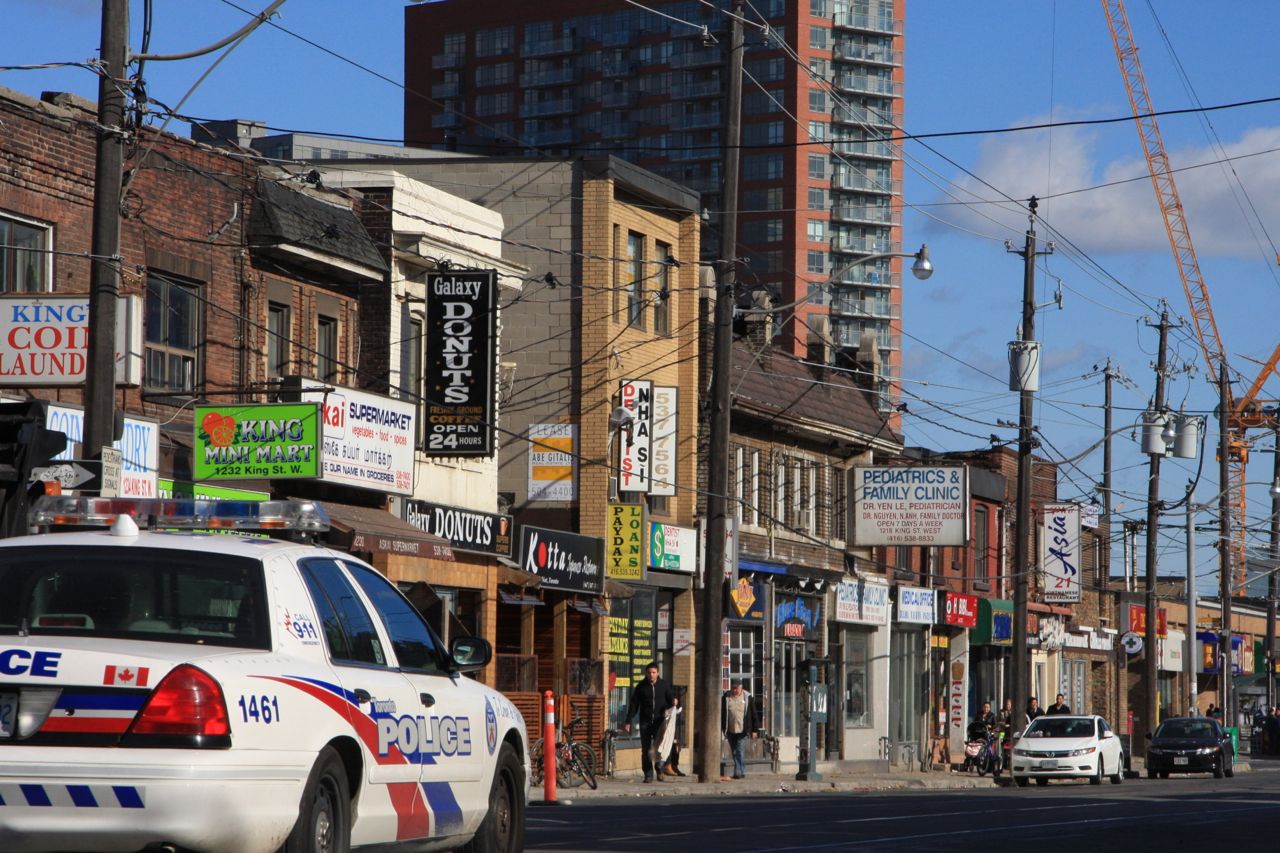
This stretch of King is an anachronism in a gentrified Toronto, a block that makes a display of poverty, rather than tucking it away in living rooms and motel rooms and restaurants. A concentration of medical institutions and an assortment of housing for the challenged, the addicted, the ill and the down-and-out sustain the establishments that cater to them.

Even the dive bars are institutional: Spartan rooms with simple tables that open in the morning and host their charges all day long. They are not welcoming places. (“There is no pizza at Nick’s Pizza Bar,” begins an outraged review on Yelp.) Regulars cluster outside the front doors of each, all day and all night, smoking, yelling, hurrying from one to the next, working through the block’s dramas.

At the payphones, a man will finger the coin slot for returns, or call the hospital and ask for a friend. At McDonalds, people hang around the planter out front, holding onto their medium-soft-drink cups so they can go inside and get another drink later. At the little plaza, sometimes people ask for money, other times they just fix you with stares.

On good days, you can float past it. On bad nights, it will get to you. City folk have a bad habit of making a fetish of the scruffy aesthetic and sneering at forbearers who fled for the suburbs. But people didn’t flee urban blight because they were unenlightened and had yet to receive the good word of Jane Jacobs. They left because urban blight can be genuinely difficult. The imaginary bohemian past is every bit as hollow as the sanitized gentrified present.

It’s 2011, though, and you can’t go too far wrong in downtown Toronto. It’s safe to live here. There are kids everywhere in the afternoons; the place is alive and they sell chocolate pastries at the Hasty Market. (In this way, I tell people, Parkdale is very much like Paris.)

And if, at night, you sit on the curb with the conversation piece of a cat that looks like it could be asleep, but is not, you’ll see people teeter on the line between keeping to themselves and nosing in, like we all have to do each day, having made the choice to live so close to so many other people.

One man appeared behind me when I wasn’t looking. He nudged the cat’s paw with his boot, and I wheeled on him. He was rumpled, maybe drunk.

“I had a cat,” he said, a bit apologetically, and stumbled onto the street. “I had a cat.”

In Parkdale, you can see the grandness of people in close quarters – the group homes, the hospitals, the community groups, the tutoring centres, the soup kitchens, the churches, libraries, the merchants, the fact that you can call 311 in the middle of the night and the municipality will do a dead animal the dignity of collecting it within an hour, because everybody’s dignity is bound up in it. And you can see that the world will stay its course anyway. It doesn’t mean that any of it is futile. Sometimes life is a harm-reduction strategy.

Animal Services arrived within an hour, at around midnight. It was a van full of cages with police lights on top. They put the lights on, and an attendant in a blue work-suit hopped out with a bag for the cat.

“It’s already stiff,” she said.

“I’ve been here a while.”

“We were up at Sheppard…” she said.

And as she bent to gather it up, a young woman on a bike rode up, looking a bit gaunt. She was one of the ones who had wondered if she knew the cat earlier. This time, she looked closer.

“Oh!” she said. “Oh no! Is that my kitty?”

“Was he neutered?” asked the attendant.

“My kitty! My kittybones!” she said, voice rising to a shriek. He’d never gone so far from home, she gasped. The attendant assured the woman that the city would keep the body in case they wanted it.

But the woman looked closer at the cat, thinking back on her own, and unsteadily reassured herself. She suddenly seemed cheerful. “I think he had white on his paws. He’s a big boy. I have to check my apartment.”

She smiled, and rode off.

Call 911: The juggernaut’s gone missing

For all the lunacy we’ve seen this week, the most striking image of Rob Ford had nothing to do with the mayor calling 911 on a TV comedian, and everything to do with sharks.

On Tuesday, Toronto’s city council passed a ban shark fins, which are often brutally harvested from live fish. It was an odd debate, which went on for hours in a packed chamber. Council, which is more used to considering rights-of-way, was suddenly considering motions – projected on a storey-high screen – like “Amend the Licensing and Standards Committee Recommendation 1 by inserting the word “illegal” before the word “shark”.” One young man, bearded and wide-eyed, showed up in a shark outfit. All the reporters asked him for a quote.

Rob Ford was not in favour of the ban. Believing that municipalities should stay out of their residents’ business, adventurous regulations that would take the city into uncharted legal waters was never his style.

But the moment of truth arrived and council finally voted, and there was a gasp in the chamber. The giant screen lit up in green “Yes” votes. Almost the entire council had voted for the ban – and against the mayor. Only three of his staunchest supporters, including the deputy mayor and Giorgio Mammoliti, his outspoken right-hand man, had voted with him.

An enormous cheer went up, and it went on, and on. Members of the Chinese community, rallied for restaurateurs’ lucrative cause, hurried for the exit. The media and public both rushed down to the edge of the council floor. The city had just made a move that would make headlines around the world, and put pressure on other levels of government. Councillors rushed to the camera lights, arms over each others’ shoulders in the crush, relishing that rarest of moments in Rob Ford’s Toronto: A good-news story.

All the while, in the empty corner of the council floor, Rob Ford sat glumly with Mammoliti, fidgeting in his chair and looking on from afar as his colleagues celebrated. In that moment, he was very much the councillor he’s always been: The guy who sits at the edge of council and the edge of town and says no, over and over, according to his principles. An outsider.

This isn’t to say that Ford is a spent force, even though the putative Ford Nation appears to have evaporated as a political entity. Just the day before, he succeeded in pushing through a contentious new round of privatized garbage collection. He will win votes and lose votes. But six months ago, he was a juggernaut, hardly losing on a single question.

In defeat, he didn’t seem to know what to do. The image of Ford looking on while formerly unwavering allies clamoured for attention was impossible to ignore.

Two days later, the 911 imbroglio erupted. The mayor had previously been rudely set upon in his driveway by CBC comedian Mary Walsh and a cameraman. After asking to pass by with a couple of nervous chuckles, Ford retreated back through his front door, where he called 911. When the police didn’t show up fast enough, Ford got agitated and called 911 again, venting his frustration on the operator.

Everyone wants to know what happened next – did Ford curse out a female 911 operator, as the CBC reported? Did he merely express his frustration in salty terms, as he and his brother claim? (When Doug Ford is doing damage control for you, and not the other way around, you know you’re in trouble.) As the claims and counter-claims escalated, a ridiculous run-in gained real stakes: Either a public broadcaster is mis-reporting damaging claims, or the mayor of Canada’s largest city is lying to protect his reputation. And either way, embarrassing personal information leaked from the city’s law enforcement.

But for Rob Ford’s relationship to the city, the damage has been done. The fact remains that, confronted by a pair of media wahoos – one of whom bore a camera, and the other he mistook for one of his old adversaries, the men-who-dress-as-women – he ran inside and dialed 911.

Days after the city was noted in the global press for the shark-fin ban, it had reclaimed its rightful place as a national laughing-stock. Mel Lastman called in the army to deal with a snowstorm because he was worried that blocked roads would hamper emergency services, and he didn’t want to risk an unnecessary death.

Rob Ford, on the other hand, dialed 911 because he was either scared of or irritated by a TV personality with a plastic sword in his driveway. Then he called back because the police hadn’t arrived fast enough. Fear and entitlement are not winning qualities in a leader. Mary Walsh’s act might be obnoxious, but Rob Ford’s helplessness is even harder to watch.

As columnist Rob Granatstein pointed out in the Star, Ford would have made a great ombudsman, using his bull-headedness to help citizens to get good customer service from city hall. He was, by many accounts, a great constituency guy. But his personal amiability didn’t scale, and he doesn’t seem to know how to handle the curveballs his job throws at him.

We’ve gone from a mayor who operated by juggernaut, to a man who, at times, hardly seems to be a mayor at all, peering in from the edge of council, peering out from his front window. We have three years left on the clock. That leaves us with two questions: Can Rob Ford learn to become a leader on the job? And if not, how will our system pick up the slack?


This piece was originally published in The Toronto Standard

Losing it

If one were to look back at this week a year from now, this most surreal of weeks, I’ll wager that the most significant moment was the one where the mayor’s press secretary started waving her arm in front of a CTV News camera.

The CTV reporter was taping a sit-down interview in Ford’s office, while Adrienne Batra, the mayor’s all-seeing, all-controlling press secretary, sat off-camera to one side. Having wrapped up an interview on a presumably serious matter, the reporter had the temerity to change topics, and ask him about the talk of the day.

You, like every man, woman and child in Canada, may have heard. Apparently, a motorist had seen Ford illegally talking on a cellphone while in traffic. Rolling down her window, she and her six-year-old daughter gave him a thumbs-down and told him to get off the phone. The mayor is said to have responded by giving the pair the finger, and mouthing a message whose particulars went sadly unrecorded.

The mayor’s climb-down from this position will not be remembered as one his more graceful maneuvers. A post on his Twitter account – written in the first person by a staffer – explained that the account was “not accurate,” and while not denying that it happened, explained that “this is a misunderstanding.”

This led many to ask exactly what kind of misunderstanding it could have been. Perhaps it was a culture gap, in which the motorist didn’t realize that in northern Etobicoke, extending the middle finger is actually a good-luck gesture, wishing the recipient fruitful progeny and smooth roads. It might have been a nasty finger-cramp, or a game of itsy bitsy spider gone tragically awry.

Eventually, some journalists cobbled together a theory under which Ford thought his finger worked as a cell phone antenna, and that he’d get better reception if he extended it and waved it around a bit. At that moment, he was simply struggling to use voice dialing function. “DIAL… MAMMOLITI! (wave, wave, frown) DIAL MAMMO– ”

It was that, or he’d totally flipped off a six-year-old.

So it was that a CTV’s Naomi Parness, sitting in his office, tried to ask the mayor what had really happened. The mayor turned pink and started laughing. His press secretary did the only reasonable thing under the circumstances: She started waving her hand in front of the camera. Batra’s plan was to spike the footage, and render it unsuitable for air. We know this, because she explained what she was doing as she did it.

“You’re done!” she said. (Wave, wave.) “See? You’re not going to be able to use it, because I’m just going to keep talking.”

CTV aired it anyway.

This came in the midst of the parallel fiasco of Doug Ford’s foray into literary criticism. Doug Ford, we can now conclusively say, is the best thing that ever happened to liberal Toronto. After the spectre of library cuts was raised by the service review process, the mayor’s brother waded into the fray with a series of incendiary pronouncements, each one more bizarre than the last, only to end in an embarrassing climb-down of his own.

First, he variously declared that there were more libraries than Tim Horton’s in his ward (there aren’t) including one in an industrial area (it’s not), which he’d shut in a heartbeat (he can’t).

This led him into a public feud with Margaret Atwood, who had been assembling a petition to save the city’s libraries. Margaret Atwood! “Good luck to Margaret Atwood,” he said. “I don’t even know her. She could walk right by me, I wouldn’t have a clue who she is.”

He added that if she wanted to be taken seriously, she should be democratically elected – presumably, like him. This did not go over well. He appeared to take Atwood as the coddled product of the downtown elite, which would make her a safe target. He missed the fact that Margaret Atwood has clout because she’s succeeded beyond his wildest ambitions in the arena he reveres most: The free market.

But those who suspect that he’s a calculated provocateur (and sometimes, I’m among them) should also consider the damage he’s done to any hope his administration had of closing libraries. Instead of taking the line that, regrettably, times are tight and efficiencies need to happen, his attention-grabbing first statements defined the administration’s position as actively anti-library, anti-book and anti-author. Many city councilors will have a hard time supporting that line.

By Wednesday night, having evidently been hauled back into line, he’d clarified his statement, explaining that he meant the exact opposite of what he said.

“What I was saying is, everyone knows who Margaret Atwood is. But if she were to come up to 98% of the people, they wouldn’t know who she was,” he said. “But I think she’s a great writer and I look forward to her input.”

His clarification, it should be noted, also says the exact opposite of what his clarification says. Misunderstandings! They’re tricky.

This kind of stuff is the Fords’ schtick. But the media’s forbearance about their goofiness is starting to shift. Constitutionally, broadcast news is the blandest, most broadly uncritical of the news media. It’s also the most likely to reach the busy, politically disengaged citizen. When you’ve lost them, you’re in trouble.

I understand that on Global’s national news Wednesday night, the Fords were compared to the Trailer Park Boys. Even members of Ford Nation might not appreciate the implication that they’re living in a trailer park. I feel for the Fords’ media wranglers: The brothers have seized control of their narrative – and this is the story they’re telling.


This piece originally appeared in The Toronto Standard.

John Graves Simcoe, this is all your fault

This week at city hall, Rob For- oh, to hell with it. Let’s talk about the weather.

Canadians are big on seasonal differentiation. A surprising amount of the world muddles through a nondescript cycle of vaguely-differentiated seasons, but not us. Toronto takes marking the seasons very seriously, in that Presbyterian way that holds that if a little misery isn’t involved, the lesson probably won’t stick.

I think about this a lot, whenever Toronto hits another climactic nadir, which it does every few months (miserable cold / miserable heat / miserable rain / cold miserable rain). The hint of masochism is strong. Why else would five million-odd people choose to live in such unwelcoming climes?

In a humid heat-wave like this, the city’s brick houses absorb heat until their hallways are warm to the touch, radiating inwards like so many pizza ovens. Cans of soup can be opened and discovered to be pre-heated. Cats lie sprawled outside on the pavement at night, long past the point of caring. If there was any substance to the theory of evolution, Torontonians would have gills by the end of the week. I could even deal with this, but in four months it’s going to be pitch black and pelting with freezing rain, yet unable to muster up a proper snowfall.

Here’s the question I always ask myself at times like this: Whose idea was it to put a city here? Sometimes the placement of cities is accidental, incremental, or lost to the shadows of time, growing from ancient sites or agrarian settlements, for whom nobody can properly be blamed.

Not Toronto. On days like today, let us remember that we’re under this weather because, long ago, a man planted his finger on a map and said, “here.” That was John Graves Simcoe. Today, it’s 38 degrees outside and 3,800 degrees inside and here we all are, stuck. It is John Graves Simcoe’s fault.

It’s true that the area had seen earlier settlements – a couple of First Nations villages up along the Humber, and an isolated and ultimately abandoned French trading post along the western lakeshore. But for the most part, Toronto was a straight-up forest before 1793.

Now, Toronto wasn’t Simcoe’s fault alone. The governor of Upper Canada, Sincoe felt that his existing capital, the border town of Niagara-on-the-Lake – called Newark at the time – was perilously to the United States, which had only recently come into being and was still kind of cooking.

His first choice for a new capital was a more defensible spot in the middle of the province, which he’d optimisically named “London,” but his boss in Kingston, Lord Dorchester, nixed the plan. So Simcoe picked out a spot on Lake Ontario that was sheltered by a yawning peninsula, offering a natural harbour and the perfect spot for a nude beach. The locals called it “Toronto.” He called it York.

Perhaps Simcoe didn’t honestly know what the weather was like here before he made his call. That’s alright; everyone makes mistakes. That’s no excuse for not fixing them. After spending a full year here, why didn’t he announce that the whole thing was a botch, pull up camp, and establish a capital somewhere else? There were plenty of places that were far from the American border. The interior of British Columbia is nice. So is Bermuda. Why aren’t we there?

Simcoe persisted. Upper Canada’s administrators and aristocrats had to be dragged from comfortable Newark, grumbling all the way, and installed in the muddy, boggy, stumpy settlement of York, which had literally just been hacked out of the woods.

As it turned out, Simcoe’s hunch about the border was right. When things with the Americans eventually got bad in the War of 1812, Newark got completely flattened. (If you go to Niagara today, you’ll see that much of the architecture is of an 1813 vintage.) The catch was, it didn’t stop the Americans from flattening York too. An army under the command of one General Zebulon Pike landed in the west end, overwhelmed the small local force and marched on Fort York. The British withdrew, setting fire to the powder magazine as they left. The enormous explosion that followed didn’t halt the Americans, but it did kill Pike, making him the first man named Zebulon to get blown up while attempting to invade Toronto.

At any rate, there is very little since then that cannot be blamed, for one reason or another, on John Graves Simcoe. The Christie Pits riots would not have happened if the Christie Pits had not existed. Hurricane Hazel could have been averted by not putting a city in the path of a hurricane. The waterfront would not have been such an imbroglio if it was still trees.

And the weather. Most of all, I blame John Graves Simcoe for the weather. This is why, on the hottest and coldest days of the year, I propose we acknowledge Simcoe’s contribution to our daily lives, by declaring it Fuck You, John Graves Simcoe Day. This is better than the existing Simcoe Day, which contains no obscenities and nobody really celebrates anyway. Let’s give it some meaning in our lives. In fact, let us name today the very first Fuck You, John Graves Simcoe Day.

As you swelter on the street or shiver by the air conditioning, reading news about a city whose chief problem seems to be with the fact that it exists when its leaders seem to rather wish it didn’t, take a moment to curse the man whose fault this all is in the first place. Damn you, John Graves Simcoe. It’s hot, and they’re talking about selling the zoo. This is all your fault.


This piece was originally published in the Toronto Standard.

There’s a word for this: Uncompetence

There is a difference between incompetence and uncompetence. Incompetence is when people make bad decisions. Uncompetence is when people start to suspect that competence is something the elites do, and think to themselves, “I should perhaps do something else.”

Welcome, everyone, to Toronto.

Here in Toronto, the citizenry are being treated to a three-ring circus of municipal upheaval, in which the self-professed guardians of taxpayer dollars are busy throwing said dollars away for reasons that seem to range from ideology to spite, which really isn’t that far of a walk.

The howling today is over the misbegotten Jarvis bike lanes, who received their death sentence today, as did already-completed bike lanes in Scarborough and putative lanes elsewhere.

Theirs, admittedly, was never a considered life. They were slapped onto the road without a proper process in the first place, at a cost of about $70,000. Once there, though, cyclists loved them. But the lanes quickly became an irritant for drivers who used the road, some of whom swore up and down that it was derailing their lives. Well-to-do Moore Park residents were incensed. In the mayoral election, Rocco Rossi was the first to scream blue murder about them, vowing their removal. Just today, councilor Karen Stintz told council a story about a mother who said the bike lanes were keeping her from family dinners. City staff had reported that the bike lanes had increased travel time on Jarvis by an average of about 4 minutes. Maybe they were a Swanson’s family.

That said, the lanes are there, and they’re being used by 900 cyclists a day—a number that would have surely grown. (It takes time for people to adjust their daily habits, after all.) The traffic slowdowns, meanwhile, were on their way to being addressed with some left-hand turn jiggery-pokery. There was never a clear case that they were a detriment to the city, as opposed to a political opportunity.
No matter. It takes a certain bloody-mindedness to de-accomplish a fait accompli at enormous expense and rebuild it one street over. Turning Jarvis back into a car-crammed five-lane arterial throws out years of planning work around making it friendlier. It will cost at least $200,000 to remove the brand-new bike lanes, and even more to build a new bikeway exactly one street over. It was incompetent to build a bike lane without proper consultation. It is uncompetent—deliberately, opportunistically misguided—to tear it up, waste the money, alienate the neighbourhood, radicalize an important community, and end up with a lousy, crammed road to show for it.

Meanwhile, in the next circus ring over, the consultants the Fords hired at great expense to hunt down all the waste in the city’s budget are reporting back this week. The results are being dribbled out day by day. So far, we’re on day three.
The surprising results are not surprising at all: The gravy is a lie. While the reports from the consultants at KPMG suggest nips and tucks, the fact remains that the city has to deliver a lot of services that are required by the province, and it’s already running a fairly tight operation. Cuts will be tough.

The week may yet turn up a surprise—the discovery, say, of a spare fire department that the city put in the closet and completely forgot it splurged for on eBay, or the realization that the planning division spends $150 million a year to Febreze the carpets—but so far, juicy targets are few and far between.

KPMG tells us we could defund the Economic Development department, which brings new business to town. Or, we could cut all arts funding. Or recycle less. Or we could stop cleaning the streets so much. (Oh, come on. It’s not like you were eating dinner off them anyway.) The mayor may have been hoping to discover piles of fru-fru to heroically cut, but so far KPMG is turning up cost-saving opportunities like this: “Funds to help Elderly and Disabled Torontonians Purchase Critical Medical Supplies.”
Incompetence is mismanaging city departments and letting costs get out of hand in the first place. Uncompetence is running on a bogus platform. Uncompetence is cutting taxes in a budget crisis, mandating deep service cuts. Uncompetence is having a better option to fix the situation, but ignoring it because it’s not your style.

(Uncompetence is distinct from hypocrisy, though they do go great together: Uncompetence is creating a consultation process that will give bogus or skewed data, and trying to stack it with your supporters. Hypocrisy is later claiming the results are invalid because they’re skewed towards your opponents, as Denzil Minnan-Wong did this week.)

And in the third, adjoining ring, the city has announced a plan to reduce staffing by offering buyouts to 17,000 employees. The ranks of the city’s 50,000-odd employees are about to get thinned in a blowout “Everyone Must Go!” sale. Ford feels that the city employs too many people, though, with regards to his civic priorities, he pronounced that “we have more than enough staff, no matter how many staff leave the city, to remove graffiti.”

Is a mass-buyout a good idea? It’s hard enough for the public sector to attract top talent in the first place, let alone at a time when the municipality is in decline, the politicians are hostile to the bureaucracy, and the leadership determined to dismantle work that so many civil servants have spent years on. The enterprising, ambitious and talented will be the first to go.

It’s a bad idea by design. That’s the nature of uncompetence: It’s a form of studied callousness employed by people who want—on some level—to dismantle the thing they govern. In the case of Rob Ford, that represents the institution of the municipality, which, he believes, shouldn’t do the bulk of the work it does.

Uncompetence holds a studied disregard for planning, for process, for advice, for consultation. Uncompetence says that if you steer from the gut and set a direction, the beast of government will moan and roar but eventually come to heel. Incompetence is the mistakes that people make while building. Uncompetence is a willful abandon, the decision that competence is really someone else’s bag of tricks. And uncompetence is useful—more useful than anything—when you’re busy trying to tear something down.

Doug Ford in the Land of Chalk Drawings

Every time he opens his mouth, Doug Ford reminds me more and more of Simon, of the Land of Chalk Drawings.

Simon was a nice guy. You might remember him from bygone days, the line-drawn hero of a British kids show known to public-television rug rats of a certain generation. Simon loved to draw on his chalkboard, where his creations assumed life, with the significant caveat that things never went entirely according to plan.

Every episode, Simon would peek over a wall into the Land of Chalk Drawings, a principality full of well-meaning but perpetually distempered citizens. Fortunately, Simon had a special power: He could go home and draw up solutions on his chalkboard – and the things he drew came true.

Which brings us to this week’s news. Once again, the elder Ford brother has had a new infrastructure idea. He was musing on it just the other day.

“If we have a firm anywhere in the world that wants to come and tunnel underneath the Gardiner all the way downtown, God bless them,” he told the Globe. “If you’re asking would I pay five dollars to get downtown quicker and not knock off 14 bicycle riders on the way down Queen Street, I’d do it in a heartbeat.”

Without having done a formal survey, I can tell you that 14 out of 14 cyclists would rather stick Doug Ford in a tunnel, too. But we’re not just talking about taking down the Gardiner and burying it, the Big Dig solution that’s been the subject of innumerable urban fantasies.

He’s thinking bigger: “What I’d really like to see is three levels, one for a train, one for the toll and one for regular traffic with no toll and let’s develop on top of the Gardiner and that would pay for itself,” he said in a Star interview the same day.

This would involve digging beneath a 50-year-old highway in such a way that it didn’t collapse, before re-engineering it to support a triple-layer cake of roads in a neat first-class, second-class, steerage arrangement.

By the time that the Globe’s Siri Agrell got around to politely pointing out that the tunnel idea had been mooted long ago and rejected on technical grounds, it was too late. News stories about Doug’s latest brain-fart were everywhere.

Doug Ford’s role at City Hall is, as I say, nebulous. He is widely credited with being his brother’s closest advisor, the Luigi, if you will, to Rob Ford’s Mario. In public, however, he’s given to spitballing infrastructure ideas that might be more at home, say, on a child’s chalkboard.

First there was the NFL stadium to be built on the cheap in the Portlands by using the foundations of a power plant, and connect it to the city with a monorail. Then he wanted to dig down in the middle of Rogers Centre to turn that into an NFL stadium. Then he wanted to rename the Spadina subway station after McDonald’s. Now, this.

I, for one, can’t wait to hear his decree for the Toronto Pleasuredome, which will be built on top of those Ontario Place pods on stilts, using even bigger stilts. It will have a zoo and a roller coaster and and separate stacked stadiums for NFL, CFL, LFL and XFL and will be accessible only by being shot out of a cannon. Sound impractical? You’re right, that would take a lot of cannons. Tell you what, let’s put a bunch of people into a monorail, then shoot the monorail out of a cannon. The private sector will pay for it all!

Sooner or later, the media will have to wake up to the realization that they’re being trolled. Doug Ford has an unrivalled ability to suck the air out of the conversation just by mooting an incredibly stupid idea, and nobody – starting with your humble correspondent – can resist an incredibly stupid idea.

As far as I can tell, Doug’s vision of infrastructure development goes as follows: He draws his ideas on a chalkboard, and thanks to the magic of the private sector, the things he draws come true – and with that, the people are happy.

Here’s the catch: Simon’s chalk drawings didn’t always work out for the best. The show was kind of fascinating in that regard. Its entire premise was that Simon was the benificent guardian of a soverign state full up troubled citizens, whose lives he was continually trying to improve by the addition of chalk-drawn infrastructure. But most of the time, his efforts backfired in one way or another, and he was forced to alter course.

Take, for instance, the episode where the children of the Land of Chalk Drawings want cars. So Simon draws them cars, which they gleefully drive about.

But cars, Simon found, had consequences. “The land was in a terrible mess,” intoned the narrator. “Fences were smashed, trees bent, and noisy smokey cars were speeding everywhere! The train driver was by his engine, miserable. Now that the children had cars, he had no passengers to carry.”

Eventually, the chalk schoolteacher implores the children to stop driving.

“The children wouldn’t listen,” explained the narrator. “They thought the train was too slow, and besides, cars were much more fun. They drove off, more fond of cars than ever.”

So Simon had an idea: He took out his chalk and drew even more cars, until there were so many cars there was just a giant traffic jam, and all the chalk people grew weary.

“Cars were alright, when only you had one,” concluded the narrator. “But whenever everyone else had one, cars were no fun at all.”

Simon in the Land of Chalk Drawings was produced in the early 1970’s, a time when Britain was still reeling from the dismemberment of its railways; car culture arrived in that green and pleasant land later, and rougher, than it did here. But its lessons ring true.

We’re blessed that Doug Ford’s magic chalk drawings don’t come true. If they did, however, they might at least provide him with an educational experience.


Originally published in The Toronto Standard

Why Vancouver’s riots are not Toronto’s protests

A burning car makes great TV. This much we can all agree on. It doesn’t, however, turn Vancouver into Toronto.

Unfortunately, the visual parallels between the Vancouver riots and the G20 in Toronto – the broken glass, the smoking street, the smoldering police cars – are leading observers to make all kinds of spurious connections between the two events. The insinuation is that they represent two sides of the same coin, or two book-ends of trans-continental mob violence.

“Torontonians bashing Vancouver rioters? That’s rich. We had G20 last yr & would likely have riots if our team lost in Stanley Cup finals,” read one of many similarly-themed tweets coursing through the Internet.

Nothing could be further from the truth.

The comparisons spring from visual comparisons, as well as persistent misunderstandings about what happened at the G20. The spate of vandalism that happened at the G20 was perpetrated by a small group over a short period of time. The rest was a rowdy, but relatively damage-free political protest that was the subject of an astounding police crackdown. The two events were different as apples and oranges.

This isn’t about Toronto vs. Vancouver. There could well be a drunken hockey mob in waiting here, too. By the same token, the G20 vandals, the G20 protestors, and the G20 police all came to Toronto from across the country. No, this is about two events that look similar on TV, but in reality have far less to do with each other than many seem to think.

Here’s why:

“It was just a handful of hooligans” is a myth in Vancouver, but a reality at the G20.

It’s always nice to blame an “outside” influence for this kind of thing. Today, Vancouver is in a tussle about whether or not there was “anarchist” involvement in the riots there.

Whether or not there were radicals in the mix in Vancouver – and surely there were – the critical distinction is that the crowd joined in, and hooliganism became a mob action.

At the G20, on the other hand, the violence was premeditated, targeted, and isolated. Moreover, the brief spate of property damage perpetrated by a few did not generate any interest in the thousands of protestors nearby.

Perhaps ironically, the bulk of the G20 protestors who were around at the time of the vandalism were far less interested in being drawn into a riot than hockey crowds were. For one thing, most were invested in the idea of peaceful protest. For another, they were sober.

There was almost no looting, and relatively little property damage at the G20.

TV images made the G20 property damage look widespread. In reality, the only major outbreak of property damage was by a group of “black bloc” vandals who waited until the end of the protest parade, and went on a quick parade of their own, breaking off in the opposite direction for a bit of infantile smash-and-run that followed a linear route.

They started near Queen and Spadina, moving east and dipping into the financial district, where a police car was torched (a disturbed, half-naked man, who I’d witnessed earlier in the day perched almost suicidally atop a war memorial, was charged), then headed north on Yonge to around College and west to Queen’s Park, where they changed clothes and dispersed. Along the way, they smashed windows of franchises that offended their sensibilities, and moved on. (The Toronto Star’s excellent report, written by reporters who followed the vandals, explains how they worked.)

I followed the vandals’ route myself, 15 minutes later. It was a mess, but there was no riot and no mob. Bystanders stood, a little dazed, some taking photos. There was no looting to be seen.

The police actions at the G20 had (sadly) little to do with the vandalism.

The G20 vandalism happened independently of the police actions that defined the event. The vandalism happened in the late-afternoon; the police violence and mass arrests only got underway after the damage was done and the vandals were gone. In fact, the police let the vandals act and disperse without lifting a finger against them.

The protestors who remained scattered across the city into the evening were certainly angry, and sometimes rowdy, but largely didn’t engage in property damage or vandalism. They gathered, they chanted, they sat on city streets where police didn’t want them. And for that, they were beaten and hauled away.

The police started deploying ever-more aggressive tactics against people on the streets, including mass arrests, kettling, riot-line charges and beatings, in the service of secret laws and spurious “breach of peace” charges. To reiterate, these were not directed at vandals, who were long gone, or even at particularly unruly protestors. Journalists were detained. People out to get groceries were detained. People out walking their dogs got detained. People who took the wrong turn on their bike were detained.

Protest is legitimate.

At the G20, it’s important to distinguish between “vandals” and “protestors.” The two are not synonymous: One is illegal and loathsome; the other is utterly necessary.

Not all of the protestors were “peaceful protestors.” There were plenty of protestors who were angry, rowdy, obnoxious, difficult, thoughtless, ill-informed, in-your-face and totally dislikeable. That doesn’t mean they ran around smashing things, or breaking the law. Whatever you make of their politics, their presence was entirely legitimate.

There was no single motive shared by the G20 protestors, just like there is no single incentive that drove the Vancouver mobs to do what they did. But let’s be clear: Protest is a legitimate thing to do on the streets of a city.

To compare a seething mob of drunken douchebags who took the chance to run amuck at the Robson St. Sears, beating those who stood against them while taking cellphone snaps of themselves going “woo hoo!”, with a group of vandals who did a run through Toronto and dispersed is inaccurate.

However, to compare a seething mob of drunken douchebags with those who protested what happened at the G20 is simply wrong.

Castles in the sand

It was down by the waterfront that Doug Ford had a Ford Notion.

Surveying the Port Lands, still a bleak sight despite years of diligent toil to renew them, the mayor’s older brother, right-hand man, and occasional mouthpiece decided that neighbourhood-building was taking too long, and the time had come to do something different instead. Something fun.

For starters, an NFL stadium, built on the foundations of the historic power station he’d demolish. Then there would be high-end retail outlets. “The Nordstrom, the Macy’s, the Guccis,” he told the Globe and Mail. “Something different. Plus, some green space — something nice.”

Linking the whole thing together: A genuine, bona fide, electrified monorail. Something that would give the city a bit of pizzazz, some razzle-dazzle, something that would make this pleasantly dull town worth visiting for a change.

Making sense of this vision is a stumper. It would, of course, mean throwing out years of work and scrapping the elaborate machinery of urban redevelopment. It would mean losing the new neighbourhoods of living and working space that were in the works. Far from speeding things up, it would mean setting the clock back on the waterfront. So what was he up to?

It’s hard to say whether Doug Ford’s pronouncements came from the heart, or were carefully calibrated to make urbanist heads explode. Possibly both.

It is true that his urban planning style doesn’t mesh with the years of methodical consultation and remediation that have already been sunk into the waterfront. The Fords seem to prefer that other kind of planning, which consists of coming up with interesting endings to sentences that start with “Wouldn’t it be cool if…?”

In defence of this way of doing business, let me be the first to say: SimCity is a lot of fun to play. You have your little bulldozer, and you can’t really consider your city a success till you’ve built a big galoot of a stadium on the waterfront. (If you’re wondering how this American ideal turns out in real life, just look at downtown Cincinnati.)

A couple of caveats are in order here. First, there’s Ford’s disclaimer that his plan was “just Doug Ford’s opinion,” representing nobody but himself, except possibly the mayor he advises every day, and maybe also the delegation of Rogers executives – known to be angling for a new stadium – who recently stopped by his office.

Second, there’s the caveat that the whole thing is insane. Where to start? Ford says his putative NFL stadium could be built on the cheap by reusing the foundations of the beautiful old Hearn generating station, which could work great if the NFL wants a stadium that’s shaped like a generating station. If you think the stadium is majestic, wait till you see the parking lot. And if you think the parking lot is majestic, wait till you see the traffic jam.

The rest of the waterfront-as-theme-park vision just gets odder. Attracting that high-end retail would be a neat trick. There is a certain kind of chain that likes building warehouse-sized outlets in the middle of nowhere, but I don’t think Ikea is Doug Ford’s idea of a good time. By the same token, I’m trying to picture Gucci advertising “the Grand Opening of Our New Wasteland Location,” but they might prefer to sell goods to customers, instead.

And then there’s the monorail. Do we, as a society, need to talk more about monorails? Ford says he was sold on the idea by an unnamed developer, leaving open the very real possibility that it was Lyle Lanley himself. There are reasons that, in the real world, you find monorails in Las Vegas, Disney World, or connecting the terminals at Newark Airport to the parking lot. A monorail is what you get when you think of transit as a ride. They’re fun, as long are you’re not trying to get anywhere at the same time as more than seven other people.

There are a few undercurrents beneath this goofiness. One is the distinction between the city as a place that people visit, and a place that people live. Urbanists want to turn the Port Lands into a breathable (and maybe even breedable) habitat for those who enjoy city living. The middle of a city is a pretty good place to do that. The Fords seem to want downtown to be a fun destination for weekend visits.

And to be fair, Doug’s not all wrong when he suggests that Toronto’s waterfront developments are short on pizzazz. With its wave-decks and little urban beaches, our new waterfront areas have a wry, liveable whimsy. But they need to be cut with some outright, brash, unapologetic attractions that draw the locals and the general public alike. Work these attractions into living, vital parts of the city, and you’ll have a success. Scrap the city and build the attractions, and the results will be like Ontario Place in February.

But I don’t sense that the Fords are here to talk urban theory. The more troubling undercurrent is shock-and-awe, the same strategy we saw when (for good or for ill) they scrapped Transit City, and as when they forcibly ejected the management and board of the Toronto Community Housing Corporation.

Doug Ford might have been sketching out his mental picture of the perfect waterfront. But it’s just as likely that his cartoony scheme was a bird flipped at the institutions of city-building: The corporations and commissions, the boards and agencies, the lawyers and consultants and renderings and reports, the residents and stakeholders and landscape architects and charettes, the hopes and years and the millions of taxpayers’ money.

The unspoken message: All of this is moot. Wait till next year, when the budget crisis hits and it’s time to start selling things. Then we’ll see who wants a monorail ride.

This article originally appeared in The Toronto Standard.